
The Scale Problem With Large Developments
Large township and urban developments present a genuinely different communication challenge than a single building. A single villa or apartment tower is relatively easy to grasp from a rendering or a walkthrough video, but a two-hundred-acre master-planned community — with residential zones, commercial areas, schools, parks, and road networks all interconnected — is much harder to understand as a coherent whole from drawings or screen-based visualization alone.
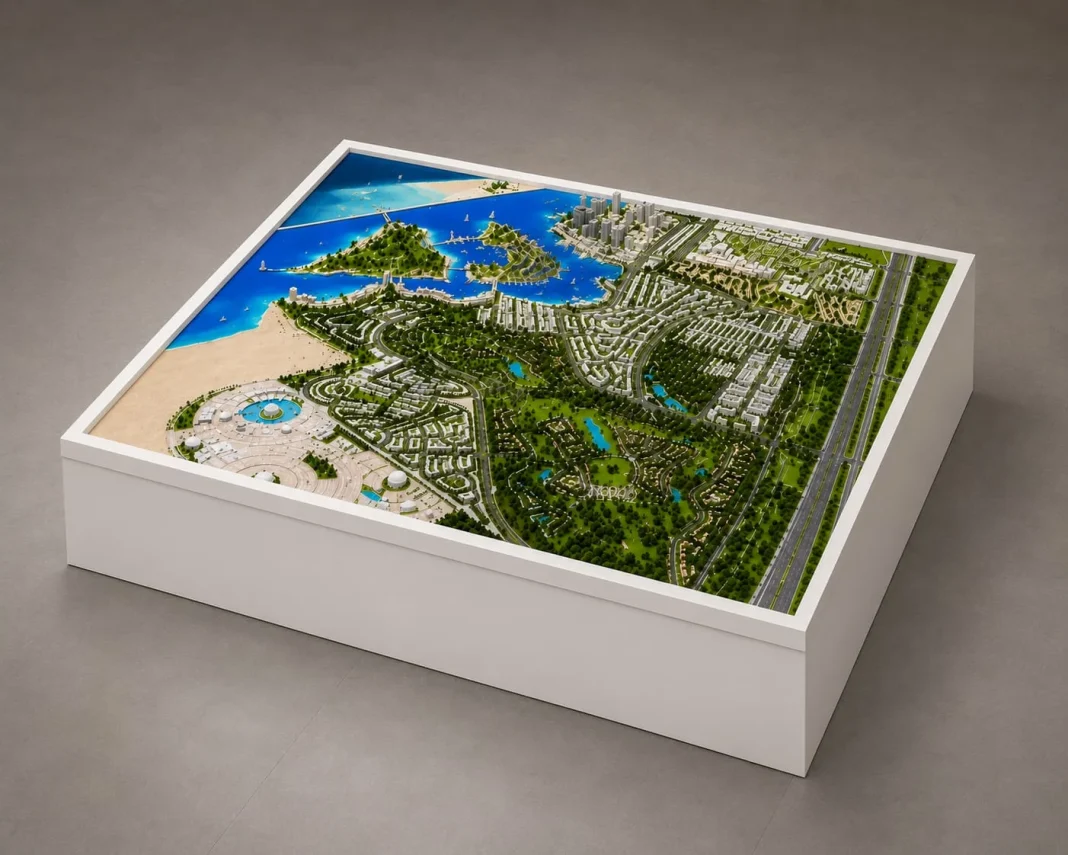
This is exactly the problem a master plan model is built to solve. By representing the entire development at a reduced scale, stakeholders can see how all the different components relate to each other spatially — where the residential zones sit relative to the commercial center, how the road network connects different phases, and where green spaces and amenities are distributed across the site — in a way that’s very difficult to appreciate from any single rendering or a series of separate drawings.
Who Actually Uses These Models and Why
Investors evaluating a large-scale project rely heavily on master plan models to understand the overall scope and phasing of a development before committing significant capital. Being able to see the entire planned community at once, rather than reviewing it piecemeal through separate documents for each phase, helps investors grasp both the scale of the opportunity and the practical sequencing of how the project will actually get built out over time.
Local planning authorities and government bodies often specifically request these models for major development approvals, since understanding the cumulative impact of a large project on traffic patterns, infrastructure demand, and surrounding land use is considerably easier with a physical representation than with a stack of separate technical drawings for each individual component of the plan.
Buyers considering a purchase within a large township also benefit significantly from this format, since understanding where their specific plot or unit sits relative to schools, parks, commercial areas, and other amenities genuinely affects their purchase decision, and a comprehensive model answers that question far more intuitively than trying to piece it together from a series of separate phase-specific brochures.
The Technical Challenge of Building at This Scale
Building a model of this scope brings its own set of technical challenges beyond what a single-building model requires. Scale selection becomes particularly important, since a development model of this size needs to be large enough to show meaningful detail across the whole site while still remaining practical in terms of physical size, weight, and transportability for exhibitions or client presentations.
Modular construction is almost essential for projects of this scale, allowing the model to be broken into manageable, transportable sections that can be assembled on-site rather than requiring an impractically large single piece to be moved as one unit. This modularity also makes future updates considerably easier, since individual sections can be revised or expanded as later phases of the development are finalized, without needing to rebuild the entire model from scratch each time.
Level of detail requires careful calibration too. A model attempting to show every individual unit’s window and balcony across a two-hundred-acre site would become impossibly cluttered and expensive to build. Skilled studios instead find an appropriate balance — enough detail to convey the character of different zones and building types, without attempting a level of individual precision that isn’t actually useful at this overall scale.
Planning for a Multi-Year Project
Because master-planned developments are typically built out over several years, it’s worth discussing update and expansion plans with the model maker from the very beginning of the commission, rather than treating the model as a single fixed deliverable. A master plan model designed with future phases in mind — accessible base sections, consistent scale and material choices across future additions — will be considerably easier and more cost-effective to expand as the project actually progresses, compared to commissioning an entirely disconnected new model each time a new phase gets announced.
For developers taking on projects of this scale, treating this kind of scaled representation as a long-term communication asset, rather than a one-time deliverable for a single launch event, tends to produce far better value across the many years a large development typically takes to fully build out and sell.
A Model That Tells the Development’s Story
Beyond its functional role in investor and buyer conversations, a well-built representation of a large development also tells a kind of story about the vision behind the project — how different zones relate to each other, how green space and infrastructure were woven through the plan, and what kind of community the developer actually set out to build. That storytelling function is worth keeping in mind during the design phase, not just the purely technical layout accuracy.
Developers who think about this narrative dimension alongside the practical planning function tend to end up with a piece that resonates more strongly with stakeholders on an emotional level too, which matters just as much as technical clarity when the goal is ultimately persuading people to invest in, buy into, or approve a shared long-term vision for a piece of land.
For a project spanning years and multiple phases, that combination of practical clarity and genuine storytelling is really what separates a merely accurate model from one that people remember long after the meeting where they first saw it.
A Long-Term Asset Worth Protecting
Given how long a master-planned development typically takes to fully build out, the model representing it deserves the same kind of long-term care and protection as any other significant marketing asset. Proper storage between uses, careful handling during transport to exhibitions or investor meetings, and periodic refreshing all help ensure the piece remains an asset rather than becoming a liability as it ages.
Developers who budget for this ongoing care from the outset, rather than treating it as an afterthought once the model has already started showing wear, tend to get considerably more value from their original investment across the many years a large-scale project typically takes to reach completion.